
The Eleventh Judicial Circuit
Florida runs a two-tier trial court system. Circuit courts are the courts of general jurisdiction. County courts handle the limited civil docket, misdemeanors, and traffic infractions. The Eleventh Judicial Circuit is the circuit court for Miami-Dade County, and unlike most Florida circuits it serves a single county. By local description it is the largest circuit in the state and one of the busiest trial court systems in the country.
The circuit hears felonies, family law, probate, guardianship, mental health, juvenile dependency and delinquency, real-property title disputes, injunctions for protection, and civil suits where the amount in controversy is more than $50,000. It also takes appeals from the county court and from some quasi-judicial boards. Cases that move beyond the circuit go to the Third District Court of Appeal in Miami, and from there to the Supreme Court of Florida in limited circumstances.
Records access reflects that breadth. The Miami-Dade Clerk of the Court and Comptroller, currently Juan Fernandez-Barquin, keeps circuit court files alongside county court, traffic, marriage, and recorded land records. Civil, family, and probate cases sit in one online system. Criminal cases sit in a separate system. Picking the right portal for the case type is the first step in any lookup. For a broader walkthrough across all record types, see the county-wide court records overview.
Circuit Court vs Miami-Dade County Court
The two trial courts share courthouses and the same Clerk, but they handle different work. A lot of confusion comes from people searching the wrong court for their case. The simple rule: if the dollar amount is above $50,000, or the charge is a felony, it is Circuit Court. If it is a misdemeanor, a small claim, or a civil traffic infraction, it is the Miami-Dade County Court. Family law and probate are exclusively circuit. Appeals from county court go up to the circuit's own appellate division before they ever reach the Third DCA.
The table below sets the two side by side on the points that come up most often. Each row reflects the jurisdictional split published by the Eleventh Judicial Circuit's court divisions page.
| Criterion | Circuit Court | County Court |
|---|---|---|
| Civil dollar threshold | Over $50,000 | Up to $50,000; small claims up to $8,000 |
| Criminal jurisdiction | Felonies (state prison or death-eligible) | Misdemeanors, criminal traffic, ordinance violations |
| Family and probate | Yes (divorce, custody, paternity, estates, guardianship) | No |
| Appeal route | To the Third District Court of Appeal | To the circuit's Appellate Division |
| Main case search | OCS for civil/family/probate; CJIS for criminal | OCS for County Civil; CJIS for County Criminal; Traffic Searches for citations |
Note: A felony arrest can still produce a first appearance hearing at the criminal courthouse before any indictment is filed, and the file lives in CJIS from booking forward.
Miami-Dade Circuit Court Divisions
The Eleventh Judicial Circuit groups its trial work into named divisions. Each one runs its own dockets, calendars, and administrative orders. Most divisions sit in one main building, but some divisions, especially Family and Domestic Violence, share space with branch courts and the Children's Courthouse. The division names below match the language on the circuit's official divisions page.
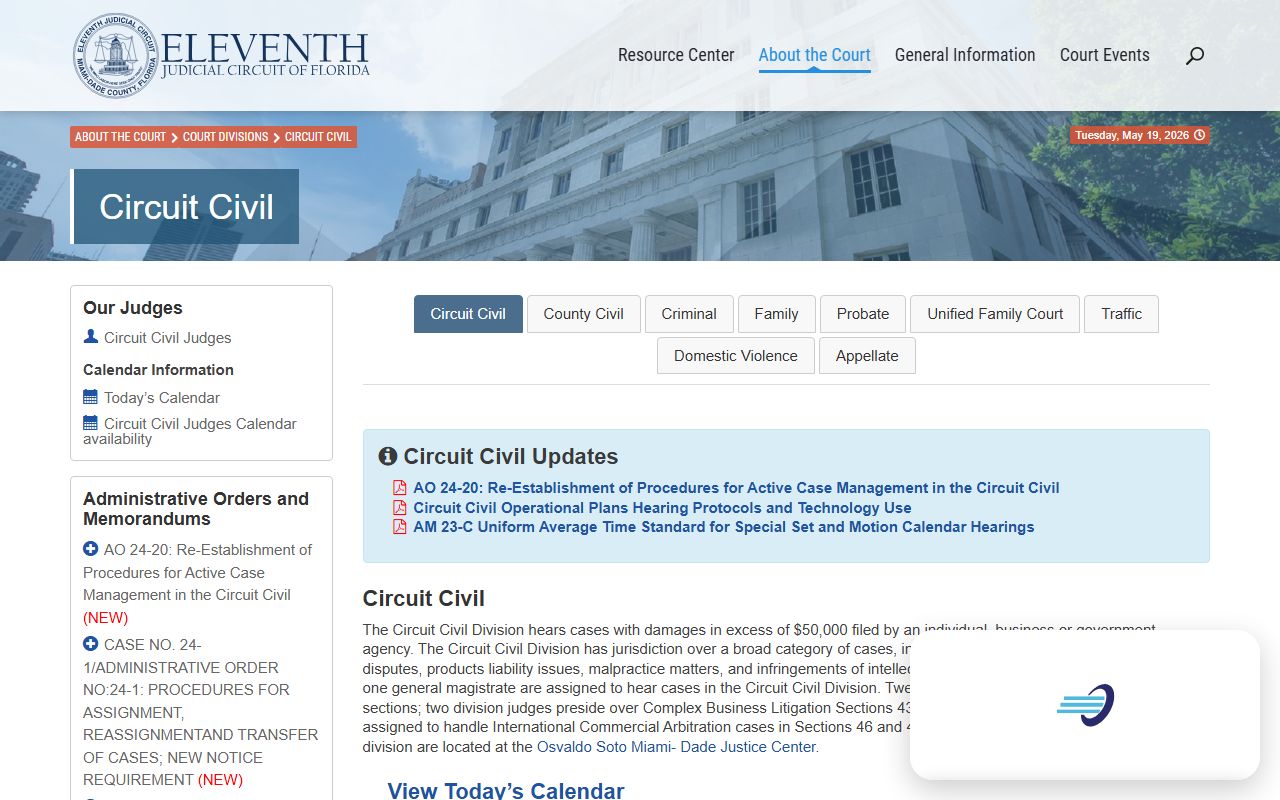
The Circuit Civil page shows the kinds of disputes that meet the over-$50,000 threshold: foreclosures, torts, breach of contract, products liability, malpractice, intellectual property, complex business litigation, and international commercial arbitration. The page also previews complex business sections used for high-stakes commercial work.
A short lead-in image from the circuit's own civil page sets the visual context for those filings, drawn from the Circuit Civil division description:
That same divisions framework runs through the rest of the court. The criminal division splits felony work from misdemeanor and criminal traffic, while probate folds in guardianship and mental health.
| Division | Jurisdiction | Main location |
|---|---|---|
| Circuit Civil | Civil disputes over $50,000, foreclosure, complex business | Osvaldo N. Soto Miami-Dade Justice Center |
| Circuit Criminal | Felonies, including grand jury indictments | Richard E. Gerstein Justice Building |
| Family | Divorce, custody, child support, adoption, paternity, name change | Family Court / Children's Courthouse depending on case type |
| Probate | Estates, trusts, guardianship, mental health, Marchman Act | Osvaldo N. Soto Miami-Dade Justice Center |
| Unified Family Court | Related family, dependency, delinquency, DV injunction crossover | Miami-Dade Children's Courthouse |
| Domestic Violence | DV misdemeanors, injunction violations, protection injunctions | Domestic Violence Division (Clerk DV line 305-349-5813) |
| Appellate Division | Appeals from county court and quasi-judicial agencies | Circuit appellate division; further review at Third DCA |
| Traffic (civil infractions) | Non-criminal traffic citations | Branch courts via Traffic Searches portal |
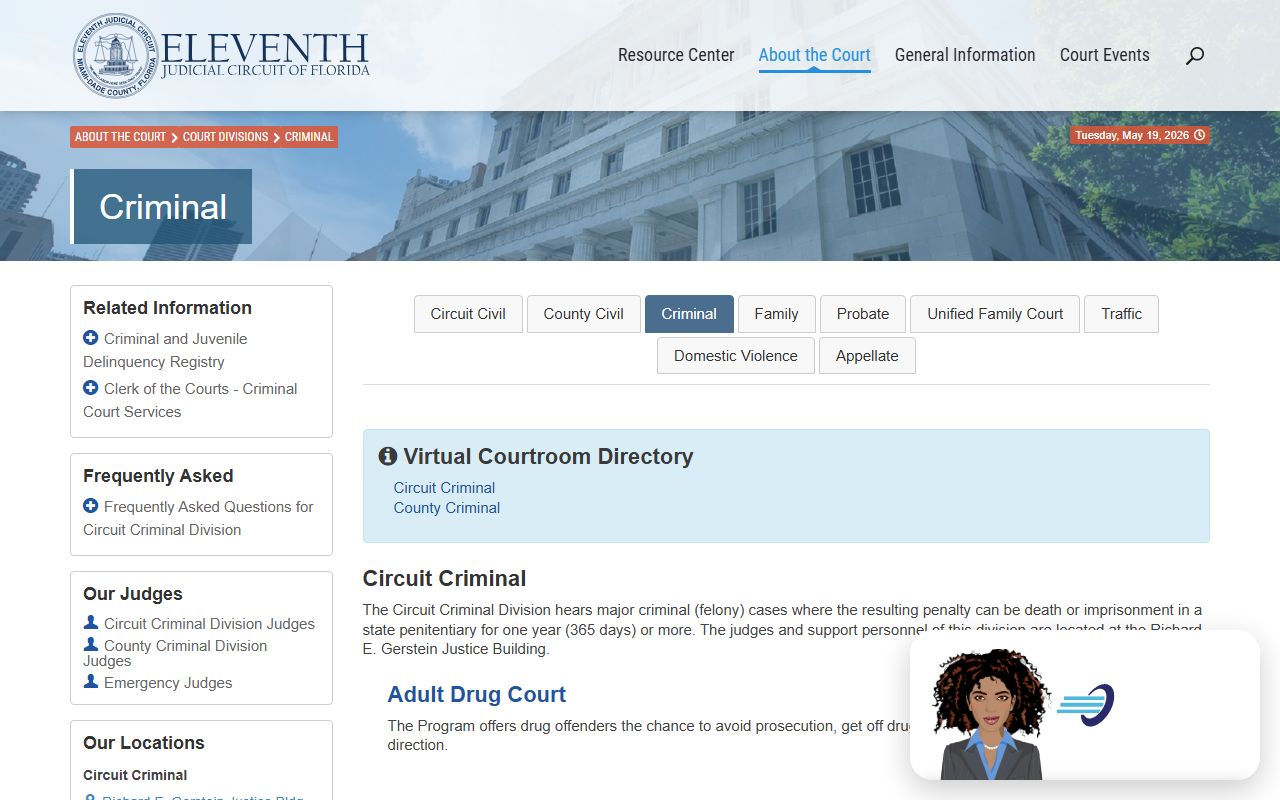
The Criminal Division page covers the felony and misdemeanor split. A view of that page is shown below from the criminal division description:
Probate sits in its own division and not in a separate probate court. Florida does not elect probate judges. The Probate Division of the Eleventh Judicial Circuit hears estates, trusts, guardianship, and mental health matters together. A look at the probate division page comes from the Probate Division page:
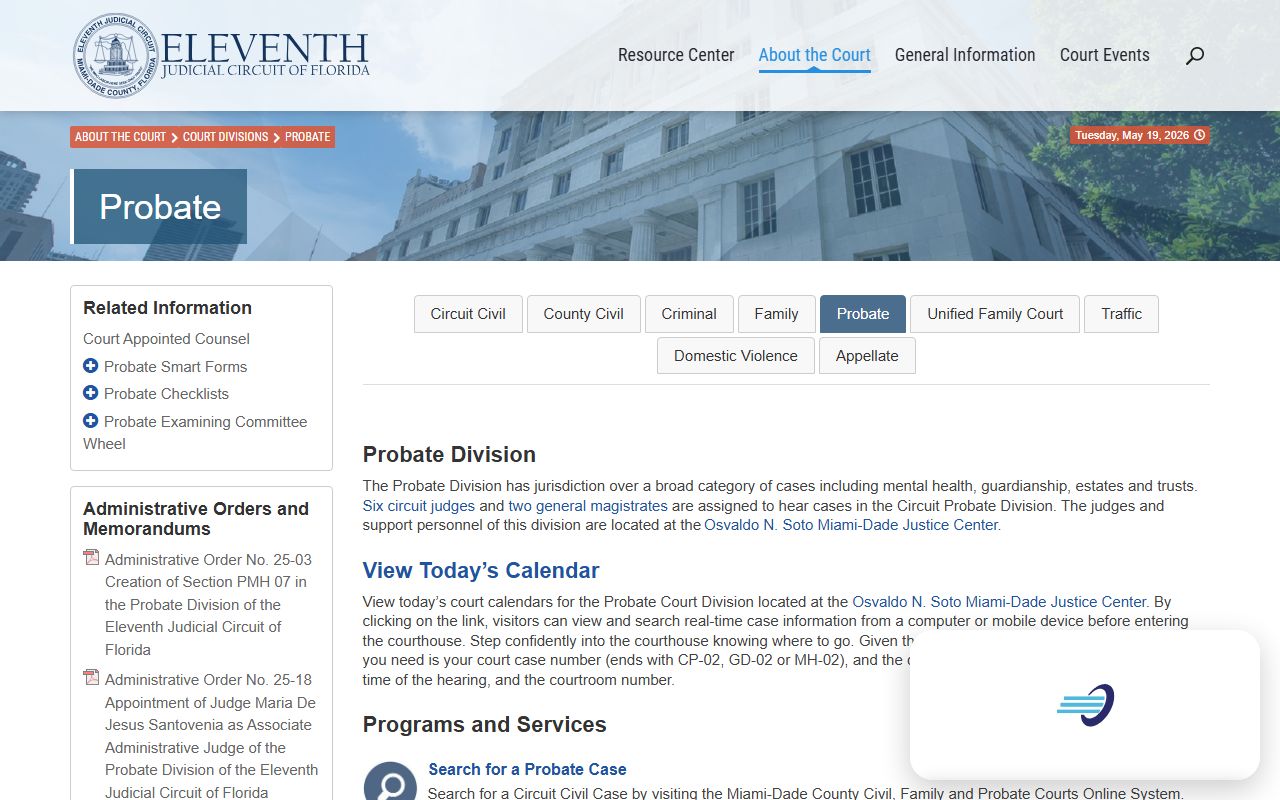
That page lists probate judges, general magistrates, calendars, and division services in one place.
Circuit Court Courthouses
Circuit work is spread across several buildings. Civil and probate sit downtown at the Soto Justice Center. Felony criminal sits a short drive away at the Gerstein Justice Building. Family and juvenile matters anchor at the Children's Courthouse. Branch courts in Coral Gables, North Dade, South Dade, Hialeah, and the Joseph Caleb Center handle satellite work. Visitors should know that downtown parking is tight, and the circuit's location pages recommend Metrobus or Metrorail to Government Center.
The contact cards below come from the circuit's courthouse locations list and the Clerk's main contact page.
20 NW 1st Avenue
Miami, FL 33128
Phone: 305-275-1155
miamidadeclerk.gov
1351 NW 12th Street
Miami, FL 33125
Hours: 8 a.m. to 5 p.m., Monday to Friday
Gerstein Justice Building page
155 NW 3rd Street
Miami, FL 33128
Transit: Metrobus or Metrorail to Government Center
Children's Courthouse page
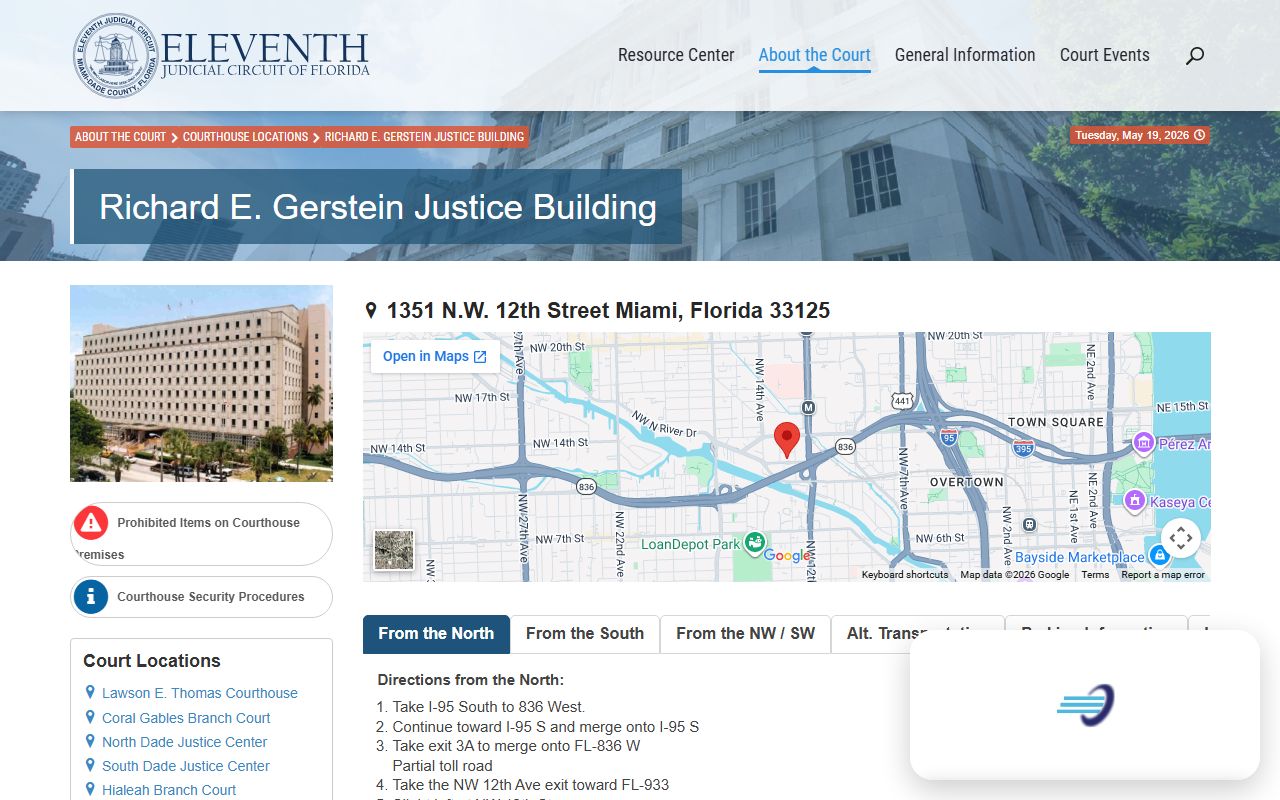
The Gerstein building handles felony filings, first appearances, and most circuit criminal trials. Its page, available at the Gerstein description, gives directions and a prohibited items list:
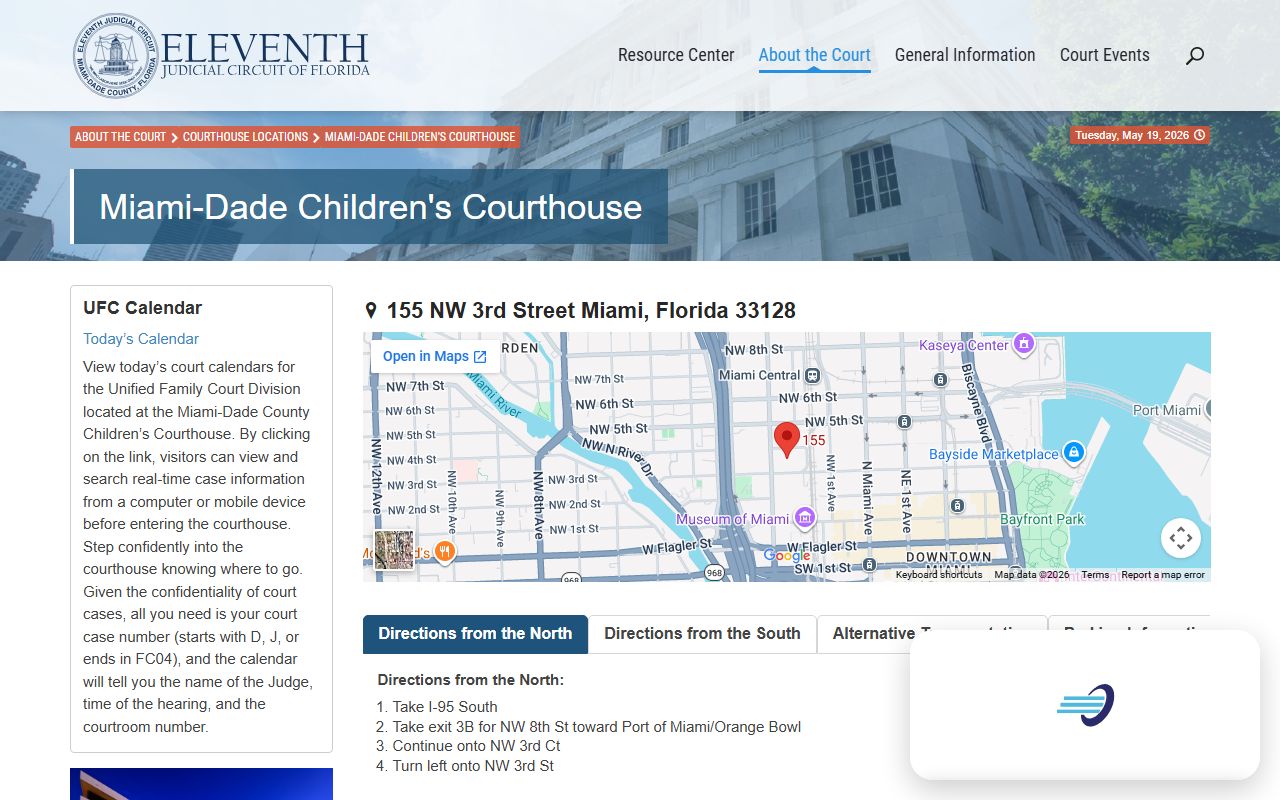
The Children's Courthouse is the working home of Unified Family Court. Its calendar lookup is case-number only by design, because juvenile and family files are confidential. The court's own description appears at the Children's Courthouse page:
Other buildings used for circuit work include Overtown Transit Village South at 601 NW 1st Court (Marriage Bureau and other Clerk services), South Dade Justice Center at 10710 SW 211 Street, and Joseph Caleb Center at 5400 NW 22nd Avenue. The Miami Beach branch court is temporarily closed for repairs per recent Clerk notices.
How to Search Miami-Dade Circuit Court Records
Circuit court records are not in one search box. The Clerk runs separate online systems for different case types, and looking in the wrong one is the most common reason a case appears to be missing. Civil, family, and probate sit in the Online Case Search, known as OCS. Criminal sits in the Criminal Justice Online Case Search, known as CJIS. Recorded land documents are in Official Records, and traffic citations are in the Traffic Searches portal. For full record-type detail, see court records and criminal records.
The walkthrough below covers a routine lookup, such as finding a foreclosure case, a divorce file, or a probate estate.
- Identify the case type. Foreclosure, large civil suit, divorce, name change, estate, and guardianship are circuit cases.
- Open the Civil, Family and Probate Online Case Search (OCS) for non-criminal lookups. Use the Criminal Justice Online Case Search (CJIS) for felony files.
- Pick a search type. OCS supports party name, local case number, state case number, attorney, hearing, and file date. CJIS supports defendant name, local case number, state case number, citation/police number, and jail number.
- Enter the value. Local OCS case numbers follow the pattern year-sequence-case code-location, for example 1973-908535-SP-05. CJIS local cases use a letter code: F for felony, M for misdemeanor, B for branch, plus the year and a six-digit sequence.
- Complete the CAPTCHA if prompted, then run the search. Registered users skip the CAPTCHA and unlock more options.
- Open the docket. Filings, hearing notices, and orders are listed in order. Some images are gated by the Florida access security matrix.
The OCS search-field layout, captured from the live application, shows the fields a user can submit on a single lookup:
| Field | Type | Notes |
|---|---|---|
| Party name | Text | Last name plus first initial or full first name |
| Local case number | Text | Year, six-digit sequence, two-letter case code, location |
| State case number | Text | 13 county prefix plus segmented format |
| File date range | Date | Filter dockets by file window |
| Hearing date | Date | Find cases by scheduled hearing |
| Attorney / Bar number | Text | Useful for case-of-record lookups |
Note: Many family and juvenile filings are confidential under Rule 2.420 and Chapter 119 of the Florida Statutes, so docket entries may show with limited or redacted detail.
Specialty Courts and Programs
The Eleventh Judicial Circuit runs several problem-solving programs that sit inside the criminal and family dockets but follow a different process. They reward treatment and compliance with reduced or dismissed charges, and they pull together the court, treatment providers, and supervision in one place.
Veterans Treatment Court is one example. The circuit's own program overview describes it as a problem-solving court for eligible veterans, with accountability and rehab built around substance use and mental health treatment. Charges can be reduced or dismissed after successful completion.
Felony Drug Court is folded into daily practice at the criminal courthouse. The Clerk's mobile criminal court page notes that special felony drug court bond hearings occur daily, and that defendants may have the chance to enter a drug rehabilitation program instead of going to trial. The Monitored Release Program (also called House Arrest) puts pretrial and sentenced participants on electronic GPS monitoring under court order.
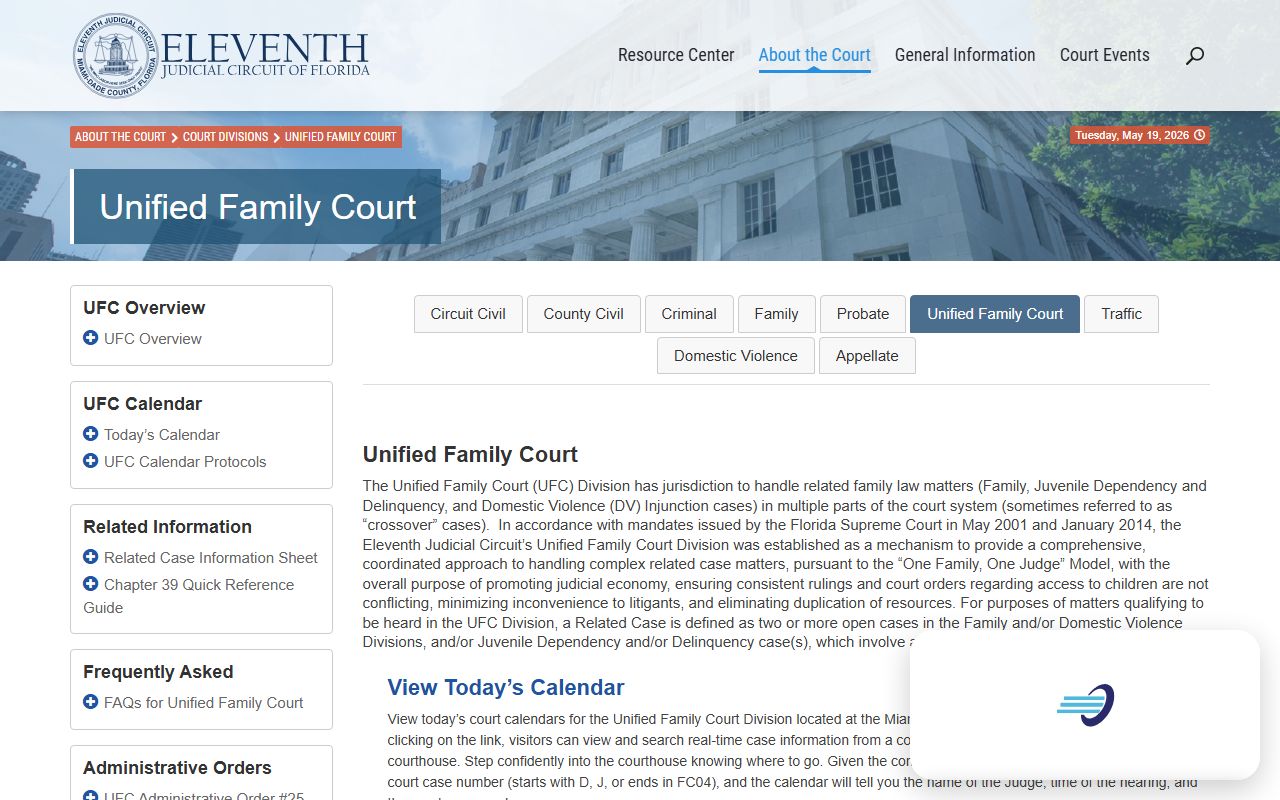
Unified Family Court (UFC) is a coordination model rather than a separate building. It was set up under a Florida Supreme Court mandate using the One Family, One Judge approach. UFC handles related family, dependency, delinquency, and domestic violence injunction cases together for the same family. A view of the UFC division page, drawn from the Unified Family Court description, follows here:
UFC's design reduces duplication and conflicting orders when a single family appears in more than one docket.
Appeals from Circuit Court
Most appeals from the circuit court go to the Third District Court of Appeal in Miami. The Third DCA is the intermediate appellate court that covers Miami-Dade and Monroe counties. Its review is generally mandatory for final orders. Some interlocutory orders, like those listed in Florida Rule of Appellate Procedure 9.130, can also be reviewed by the DCA on a non-final basis.
From the Third DCA, further review is limited. Litigants can ask the Supreme Court of Florida to take discretionary review where the case raises a question of great public importance, conflicts with another DCA decision, or expressly construes a state or federal constitutional provision. The Supreme Court takes mandatory jurisdiction in narrow categories, including death penalty appeals and certain final orders involving statutes held unconstitutional.
Appeals from the circuit's Appellate Division (which itself reviews county court rulings) generally end at the DCA only on certiorari, not as of right. The path matters: filing an appeal in the wrong forum can cost a litigant the deadline, since notices of appeal are jurisdictional.
Circuit Judges and Magistrates
The Eleventh Judicial Circuit seats a large bench. Local descriptions call it the largest circuit in Florida, and the judge count reflects that. The Circuit Civil page references the count of circuit judges hearing general civil dockets. Other divisions follow the same scale.
As a single example: the Probate Division alone lists six probate judges plus two general magistrates assigned to estate, guardianship, and mental health cases. General magistrates assist the bench by hearing certain matters under referral and producing reports and recommendations. Family Court uses the same kind of structure for child support and other referred matters.
Judges are circuit-wide elected positions in Florida. They serve six-year terms. Vacancies are filled by gubernatorial appointment from a list submitted by the Eleventh Circuit Judicial Nominating Commission, and the appointee runs in the next general election.
Filing Fees and Certified Copies
The Clerk sets the fees for filings, copies, and search work. The amounts that come up most often for circuit cases are listed below. For the full schedule, the office to call is the Clerk of Court.
| Item | Fee |
|---|---|
| Criminal certified copy / disposition letter | $7 |
| Unknown criminal year/case search | $2 per year per name |
| Recorded document copy | $1 per page |
| Certification of recorded document | $2 |
| Records staff search | $2 per name per year |
| Official Records advanced search | $1 per search unit |
| Recording most documents | $10 first page; $8.50 each additional page |
Mail requests for certified criminal copies go to the Richard E. Gerstein Justice Building, 1351 NW 12th Street: Suite 9000 for felonies, Suite 8100 for misdemeanors, Suite 124 for traffic. Most online standard searches are free, but advanced Official Records searches require purchased units. For the full fee structure, statutory authority, and request methods, see the Clerk of Court page.
How a Case Moves Through the System
The trial-to-appeal path in Miami-Dade follows a clean line. Most cases start at the trial level. They climb up only if a party appeals, and very few go all the way to the top.
Case-flow diagram (state cases): County Court › Circuit Court (Appellate Division for county-court appeals; trial level for circuit cases) › Third District Court of Appeal › Supreme Court of Florida
Within the circuit, a typical criminal case runs: Arrest › First Appearance › Indictment or Information › Arraignment › Pretrial › Trial › Sentencing › Appeal. A typical civil case runs: Complaint Filed › Answer › Discovery › Mediation › Trial › Final Judgment › Appeal. Both tracks plug back into the same docket and search systems described earlier.