
Miami-Dade County Warrant Search
There is no single public active-warrant list for Miami-Dade County in the official sources. Criminal warrants are tied to criminal court and law-enforcement systems instead. The Clerk's criminal page says Circuit Criminal receives and processes felony affidavits of probable cause, grand jury indictments, and arrest warrants. That means a warrant often shows up as part of a criminal case, not as a standalone entry.
The practical path is to search the Criminal Justice Online Case Search for the related case, then check the MDCR Inmate In-Custody Search if the person may already be arrested. Warrant-related docket entries can appear in a public criminal case, but sealed warrants and juvenile matters will not. Online data is never a complete warrant check.
Types of Warrants and Holds in Florida
Florida uses several kinds of warrants and custody holds. Each one starts in a different way and can affect bond and release. The list below defines the common types found in Miami-Dade cases.
- Arrest warrant
- Issued to take a person into custody based on probable cause or charging papers.
- Bench warrant / capias
- Often issued after a failure to appear, a violation of a court order, or a probation issue.
- Search warrant
- Authorizes a search of a place, person, or property, and is often sealed before it is carried out.
- Fugitive / extradition hold
- Held for another jurisdiction; extradition hearings are held Monday through Friday at 9 a.m.
- No-bond hold
- Custody status that shows no bond, so the person cannot simply bond out.
- ICE or federal detainer
- A federal or state hold that can block release even when local bond is satisfied.
Capias vs Arrest Warrant in Florida
Florida law uses the word capias where some states say bench warrant. The two terms cause a lot of confusion, so it helps to separate them.
Capias: A capias is the Florida arrest writ a judge issues from the bench, most often after a defendant misses a court date or violates a court order. An arrest warrant, by contrast, usually starts a case based on probable cause before any court appearance. Both can lead to arrest and booking.
CJIS Search Fields for Warrant-Related Records
Because warrants attach to criminal cases, the criminal portal is the main search tool. The fields below come from the live CJIS application and let you find the case a warrant belongs to.
| Field | Type | Required | Notes |
|---|---|---|---|
| Defendant Last Name | Text | Conditional | Search criminal cases by defendant |
| Defendant First Name | Text | Optional | Narrows results |
| Date of Birth | Date | Optional | Narrows a name search |
| Case Code | Dropdown | Yes for case search | B Branch, F Felony, M Misdemeanor |
| Case Year | Dropdown | Yes for case search | 1925 through current year |
| Case Sequence | Text | Yes | Six digits |
| Citation / Police Number | Text | Yes for that method | Where a warrant ties to a police or citation number |
| Jail Number | Text | Yes for jail search | Seven digits plus jail year |
Checking Custody After an Arrest
If a warrant has already been served, the person will be in the county jail and visible in the in-custody search. That record shows charges, bond, and a jail number. For bond amount or release status, the county says to call inmate information at 786-263-7000. Full roster details, mail rules, and deposits sit on the Miami-Dade inmate records page.
The image below opens the county's inmate contact and visitation service page, part of the same hub used to confirm custody.
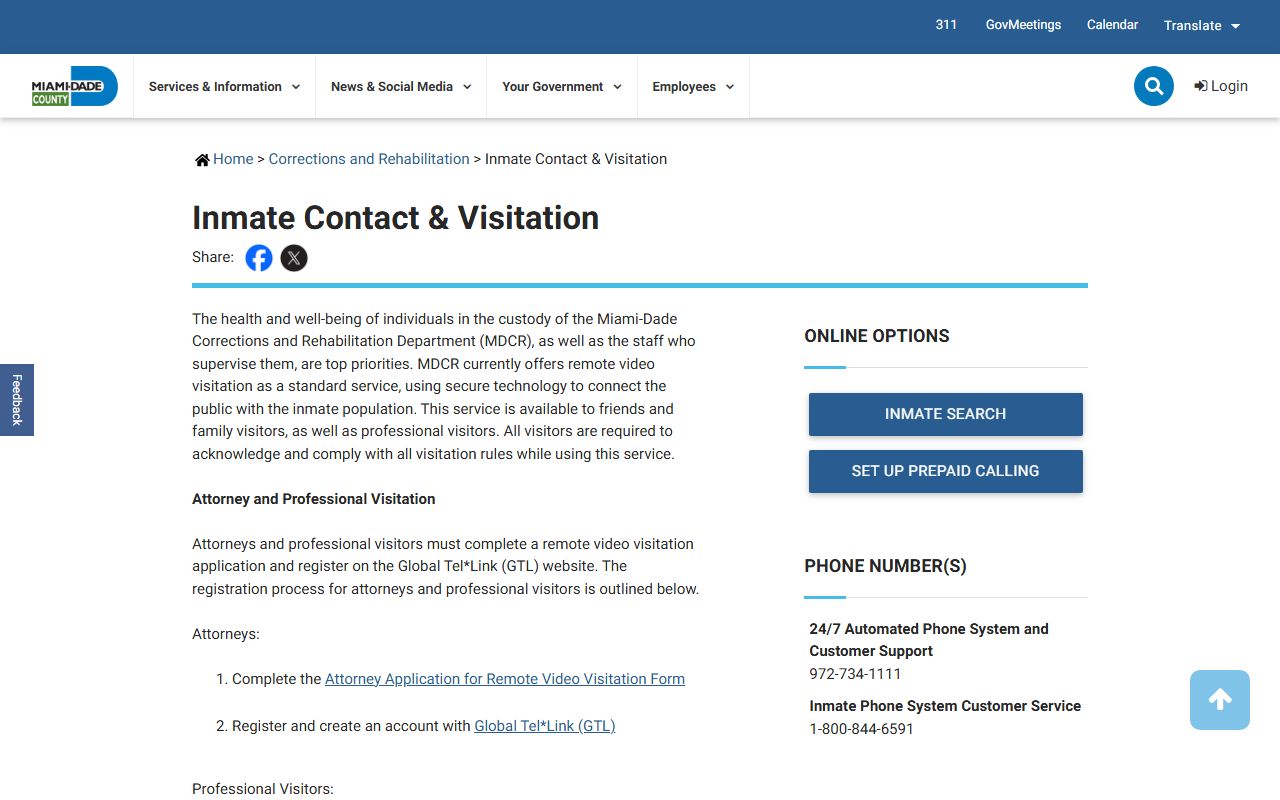
Confirming custody is often the fastest way to learn whether a warrant has been acted on.
Fugitive cases follow their own track. When a person is held on a warrant from another jurisdiction, the county holds fugitive extradition hearings Monday through Friday at 9 a.m. At that hearing a judge decides whether the defendant waives extradition or asks for further hearings. A federal or state detainer can keep a person in custody even after a local bond is posted, so the custody record may show a hold that local bond cannot clear.
How to Resolve an Outstanding Warrant
Handling a warrant the right way protects your rights and can affect bond. The steps below outline a careful approach.
- Search CJIS for the related criminal case by defendant name, case number, citation, or jail number.
- If the person is in custody, check the MDCR inmate search for bond amount, charges, and jail number.
- Call inmate information at 786-263-7000 for bond or release status after an arrest.
- Contact a criminal defense attorney, or the Public Defender if you cannot afford counsel and qualify.
- Do not treat online data as complete; sealed or recently issued warrants may not appear.
- After the matter resolves, confirm the docket updates and that any capias is recalled, quashed, or satisfied.
Important: Talk to a lawyer before turning yourself in, so you understand bond eligibility, first-appearance timing, and your rights.
Sealed Warrants and Records That Will Not Appear
Public search tools leave out several categories. Sealed search warrants are kept confidential, often until after they are carried out. Juvenile matters are restricted under Florida law and Rule 2.420. Recently issued warrants may not be entered into a public-facing system yet. For the wider rules on what is public and what is closed, see the Miami-Dade public records page.
Defense Counsel and the Public Defender
Anyone facing a warrant can benefit from counsel. The Miami-Dade Public Defender, Carlos J. Martinez, represents people who cannot afford a private attorney and face loss of liberty. The office handles about 75,000 cases a year and can be reached at 305-545-1600. For the underlying charges behind a warrant, the Miami-Dade criminal records page covers CJIS searches, dispositions, and sealing or expunction.