
Searching Miami-Dade Criminal Records
The Clerk of the Court and Comptroller runs the Criminal Justice Online Case Search (CJIS) for criminal cases. CJIS covers felony, misdemeanor, and branch cases. You can search by case number, state case number, citation or police number, defendant name, or jail number. Standard searches are free, though users who are not logged in must clear a CAPTCHA. Registered users skip the CAPTCHA and reach more features.
Arrest records are a separate thing from court records. An arrest is a law-enforcement event recorded at booking by Miami-Dade Corrections and Rehabilitation. A criminal case record begins when the State Attorney files charges with the Clerk. Someone can be arrested and never charged, and a charge can be dropped or end in acquittal. Use the Miami-Dade inmate records page to check current custody, and this page plus court records for the case file itself.
The CJIS portal opens to a search menu. The screenshot below links to the live system.
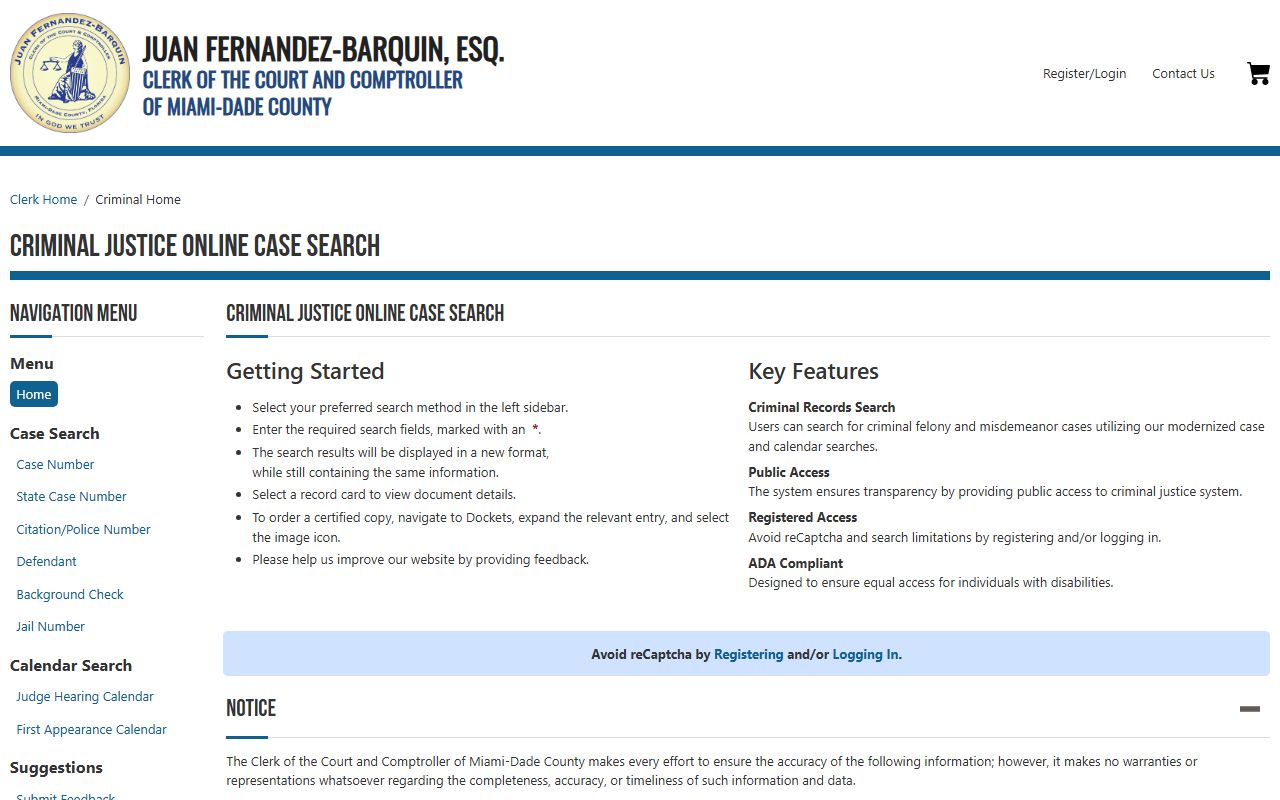
From the CJIS menu a searcher picks the method that matches the information they already have.
Felony and Misdemeanor Cases in Miami-Dade
Florida splits criminal jurisdiction by severity. Circuit Criminal in the Eleventh Judicial Circuit hears felonies, which carry possible state prison time of one year or more or, in capital cases, death. County Criminal hears misdemeanors, criminal traffic, and county or municipal ordinance violations. The split matters when you search, because the case code in CJIS tells you the court level.
CJIS case codes are short. B stands for Branch, F stands for Felony, and M stands for Misdemeanor. A local criminal case number combines the case code, the case year, a six-digit sequence, and an optional suffix for co-defendants. The State Attorney's office uses examples like F12001234 for a felony and M12001234 for a misdemeanor. Knowing the code helps you confirm you are reading the right file.
CJIS Criminal Search Fields
The criminal portal offers several search methods. Each one needs different inputs. The table below lists the main fields drawn from the live application.
| Field | Type | Required | Notes |
|---|---|---|---|
| Case Code | Dropdown | Yes for case search | B Branch, F Felony, M Misdemeanor |
| Case Year | Dropdown | Yes | 1925 through current year |
| Case Sequence | Text | Yes | Six digits, numbers only |
| Suffix | Text | Optional | Co-defendant letter if any |
| State Case Number | Segmented | Yes for that method | Begins with county ID 13 |
| Citation / Police Number | Text | Yes for that method | Single field |
| Defendant Name | Text | Yes for name search | Last and first name |
| Date of Birth | Date | Optional | Narrows a name search |
| Jail Number | Text | Yes for jail search | Seven digits plus jail year |
| Calendar Type | Dropdown | Yes for calendar | Bond Hearing or Jail Arraignment |
Note: CJIS document images and the Order Certified Copies workflow may need login, and access depends on the Florida Supreme Court Access Security Matrix.
Arrest Records vs Criminal Case Records
People often expect one search to show everything. It will not. The arrest record and the court case record live in different systems run by different agencies. The comparison below shows the split.
| Criterion | Arrest Record (MDCR) | Criminal Case Record (Clerk) |
|---|---|---|
| Source | Miami-Dade Corrections, Sheriff | Clerk of the Court and Comptroller |
| Created when | At booking into custody | When the State Attorney files charges |
| Where to look | MDCR In-Custody Search | CJIS |
| Contents | Booking info, charges, bond, jail number, mugshot | Charging documents, pleas, motions, orders, disposition, sentence |
| Stays after release | Booking event remains | Full case history remains unless sealed |
For active warrants tied to a case, see Miami-Dade warrant records. To find someone currently held, use the inmate records page.
Reading a Florida Criminal Disposition
The disposition is the outcome of each charge. Florida uses some terms that surprise first-time readers. A charge is only an accusation. A conviction means a judgment of guilt. Florida also allows a withhold of adjudication, where the judge accepts a plea or finding of guilt but withholds formal adjudication, so the person avoids many civil effects of a conviction.
- Capias
- A Florida arrest writ, often issued after a failure to appear.
- Withhold of adjudication
- Guilt is established but no formal conviction is entered.
- ROR
- Release on own recognizance, with no cash bond.
- Indictment
- A grand jury charging document, used for the most serious felonies.
- Information
- A charging document filed directly by the State Attorney.
- Surety bond
- A bond posted through a licensed bail bond agent.
Sealing vs Expunction in Florida
Florida treats sealing and expunction as two different forms of relief. Sealing restricts public access while leaving the record with named agencies. Expunction generally requires those agencies to destroy or obliterate the record, with narrow exceptions. The governing statutes are Florida Statute 943.059 for sealing and Florida Statute 943.0585 for expunction.
| Criterion | Sealed | Expunged |
|---|---|---|
| Public visibility | Hidden from public search | Destroyed, treated as if it never existed |
| Law enforcement access | Limited access remains | Very limited; statute lists who can see it |
| First step | FDLE certificate of eligibility | FDLE certificate of eligibility |
| Common denial reason | Prior adjudication or prior relief used | Ineligible offense or pending charge |
A petitioner usually must get a certificate of eligibility from the Florida Department of Law Enforcement before filing in the court that handled the case. Juvenile records may be automatically expunged under Florida Statute 943.0515 depending on age and outcome. The Clerk cannot give legal advice or complete petitions.
Disposition Letters and Certified Copies
The Clerk issues certified criminal history disposition letters for $7. If you do not know the year or case number, the Clerk adds a search fee of $2 per year per name. Requests can be made online, by mail, or in person. Mail goes to the right suite at the Richard E. Gerstein Justice Building by case type.
Criminal records mail addresses (Gerstein Justice Building, 1351 NW 12th St, Miami, FL 33125):
Felony requests: Suite 9000. Misdemeanor requests: Suite 8100. Traffic requests: Suite 124.
For the full fee schedule and request methods, see the Miami-Dade Clerk of Court page.
Felony Drug Court and Specialty Programs
Miami-Dade runs several problem-solving programs that can change a criminal outcome. Felony Drug Court holds special bond hearings daily at the criminal courthouse, where qualifying defendants can enter a drug rehabilitation program instead of going to trial. The Miami-Dade Veterans Treatment Court serves eligible veterans with substance use or mental health needs, and successful completion can lead to dismissal or charge reduction. More detail on these programs sits on the home page specialty courts section.
State Attorney, Public Defender, and Victim Services
Two offices anchor criminal cases in the Eleventh Judicial Circuit. The State Attorney prosecutes. The Public Defender represents people who cannot afford private counsel. Florida uses the title State Attorney, not District Attorney.
State Attorney, 11th Judicial Circuit
Katherine Fernandez Rundle
E.R. Graham Building, 1350 NW 12th Avenue
Miami, FL 33136-2111
305-547-0100
Miami-Dade Public Defender
Carlos J. Martinez
1320 NW 14th Street
Miami, FL 33125
305-545-1600
The Public Defender handles about 75,000 cases a year and helps former clients find work, seal or expunge records, and restore civil rights. The image below opens the Public Defender homepage.
The Miami-Dade Sheriff's Victim Services Program adds crisis support, compensation referrals, and a Hate Crimes Unit shared with the State Attorney's office.
Restricted Criminal Records in Miami-Dade
Some criminal records never appear in a public search. Juvenile delinquency files are confidential under Florida law and Rule 2.420. Sealed and expunged records are removed from public search tools. Grand jury material and active investigative information are also protected. Victim identifying information may be shielded under Marsy's Law.
Important: This site is not a consumer reporting agency under the FCRA, and its data may not be used for employment, tenant, credit, or insurance screening.