
Florida Public Records Act
Florida's open-government scheme starts in the state constitution and runs through Chapter 119 of the Florida Statutes. Article I, Section 24 of the constitution sets a right of access to public records, and Chapter 119 spells out the details. Florida Statute 119.011 defines public records broadly to include documents, papers, maps, photos, recordings, and data made or received in official business.
The right is broad. County policy says a requester does not have to give a name, explain a reason, or put the request in writing. Email itself is a public record, so the Clerk warns that messages sent to its offices may be released. The court-records side adds a layer through Florida Rule of General Practice and Judicial Administration 2.420, which governs access to and protection of judicial branch records.
What Records the Clerk Maintains
The Miami-Dade Clerk wears several hats. As court clerk, county recorder, comptroller, and clerk to the Board of County Commissioners, the office holds a wide range of records. The list below covers the main categories.
- Court case files for civil, family, probate, and criminal matters.
- Official Records, including deeds, mortgages, liens, plats, and judgments.
- Traffic citations and civil infraction records.
- Marriage license records.
- Board of County Commissioners records and minutes.
- Value Adjustment Board, tax deed, and code enforcement records.
Other county agencies hold their own records, such as the Sheriff's Central Records Bureau for arrest forms, police reports, and crash reports. The right office depends on the record you need.
Many recorded documents are searchable online without a formal request. The Clerk's Official Records system lets you search deeds, mortgages, liens, and judgments by party name, clerk file number, book and page, or legal description. Standard searches are free, while advanced searches use purchased units at $1 each. For records that are not online, or for certified copies, a request to the recorder or the relevant office is the route. The recorder's mailing address is 20 NW 1st Avenue, Suite 5.246, Miami, FL 33128.
How to File a Public Records Request
Requests can be made several ways, and the county keeps the process simple. You can use the online tool, call, mail, or email. The steps below outline a clean request.
- Identify the office that holds the record, such as the Clerk, the Sheriff, or a county department.
- Describe the records you want as clearly as you can, with names, dates, or case numbers if known.
- Submit by the county online public records tool, by phone at 305-499-8729, or by email to the right office.
- For Clerk records, requests can go by mail or email, and a control number is assigned after receipt.
- Pay any copy or labor fees, then receive the records in the format available.
The county publishes its request policies with the fee model and anonymity rules.
What to Include in a Request
You do not need a formal form, but a clear request gets a faster response. The table lists what helps, even though only a description is truly needed.
| Field | Required | Notes |
|---|---|---|
| Requester name | No | Florida allows anonymous requests |
| Description of records | Yes | The clearer the description, the faster the response |
| Date range | No | Narrows the search |
| Case or document number | No | Speeds up court and recorded-document requests |
| Format preference | No | Paper or electronic where available |
| Contact for delivery | No | Needed only if you want records sent to you |
Public Records Fees
Miami-Dade follows the Chapter 119 fee model. Copies carry a per-page charge, and a service charge applies when research or processing takes real staff time. The table lists the common amounts.
| Item | Amount |
|---|---|
| Single-sided page | 15 cents |
| Double-sided page | 20 cents |
| Certified copy | $1 per page |
| Service charge | Labor cost when research or processing exceeds 20 minutes |
Clerk court and official-record copy fees can differ by service and statute. The full Clerk fee schedule is on the Clerk of Court page.
Response Timelines and Enforcement
Florida law requires a prompt, good-faith response, though it does not set a single fixed deadline for every request. Chapter 119 disputes get priority in court under Florida Statute 119.11, which provides an accelerated hearing. Courts may award attorney fees under Florida Statute 119.12 when an agency unlawfully refuses access. For judicial records, Rule 2.420 controls motions and determinations of confidentiality.
Police, Arrest, and Crash Reports
Law-enforcement records are a common public-records request, and they do not come from the Clerk. The Miami-Dade Sheriff's Central Records Bureau handles arrest forms, police reports, crash reports, and police clearance letters. Crash reports are also sold through the state motor vehicle agency. A request for these documents goes to the law-enforcement custodian, not the court clerk.
The county also publishes a public records request FAQ with an online tracking tool. The image below opens that FAQ page.
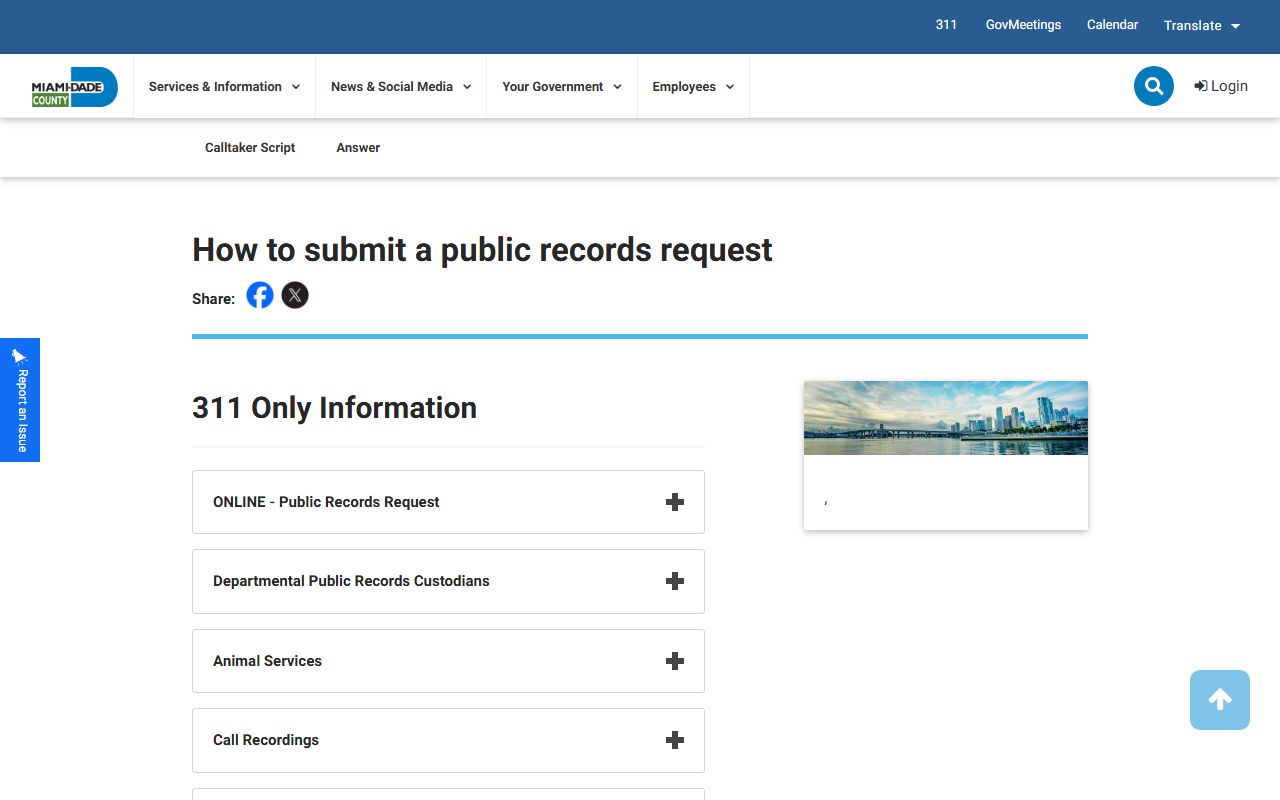
That page explains how to track a request and where to send Clerk-specific public records requests.
Records That Are Exempt
Not everything is open. Florida Statute 119.071 lists general exemptions for personal, victim, law-enforcement, and security information. Sealed and expunged criminal records, juvenile matters, adoption files, many mental health records, and confidential family and probate material stay closed. Personal data such as Social Security, bank account, and credit card numbers is redacted, and the Clerk's Official Records page offers a redaction request process. The court-record rules are detailed on the court records page.