
How to Search Miami-Dade County Court Records
Miami-Dade court searching is split across four official portals, not a single search box. The Clerk maintains the Civil, Family and Probate Courts Online System (OCS), the Criminal Justice Online Case Search (CJIS), the Traffic Searches application, and the Official Records system for deeds, mortgages, liens, and judgments. Picking the wrong portal is the most common reason a record is not found.
The Clerk Records page lists what each system is for at miamidadeclerk.gov. The Records page on the Clerk site shows the full menu of standard and advanced services. The image below opens the Clerk records hub.
The image links to the Clerk records page where each portal is listed and described.
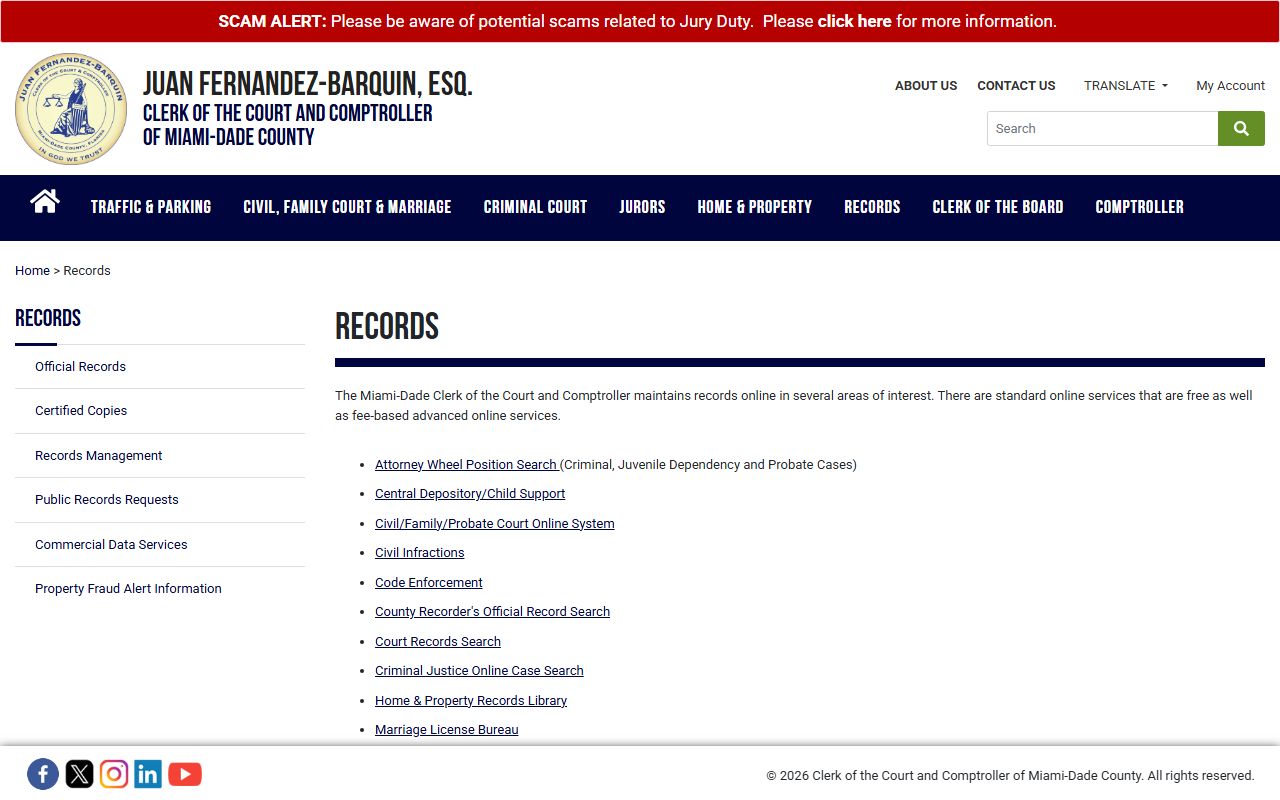
From that page a user can jump into any of the search systems without guessing which application covers the case type at hand.
- Pick the right portal: OCS for civil, family, and probate; CJIS for criminal; Traffic Searches for citations; Official Records for recorded instruments.
- Choose a search method in the left menu. OCS supports party name, local case number, state case number, hearing date, file date, attorney bar number, and related-case searches.
- Enter the required fields. Party-name searches in OCS need at least three characters in the last name, and a first initial avoids long result lists.
- Solve the CAPTCHA if you are not logged in. Registered users avoid CAPTCHA and unlock advanced filters.
- Open a result card. Document images may be viewable based on the Florida Supreme Court Access Security Matrix.
- Order a certified copy if you need one for a bank, employer, or court. Plain online copies are not certified.
Note: OCS, CJIS, and Traffic Searches are React applications. The page text only appears after JavaScript loads, so older browsers and strict content blockers can mask the search box.
The Miami-Dade County Judicial System
Florida runs a two-tier trial court system. Circuit courts hear the heaviest cases. County courts hear lighter matters. Above them sit the District Courts of Appeal and the Supreme Court of Florida. Miami-Dade is the only county in the Eleventh Judicial Circuit, and appeals from Miami-Dade trial courts go to the Third District Court of Appeal in Miami.
The Eleventh Judicial Circuit division page lays out which division hears what. Circuit Civil hears civil cases with damages above $50,000. County Civil covers cases up to $50,000 and small claims up to $8,000. Circuit Criminal hears felonies. County Criminal hears misdemeanors, criminal traffic, and ordinance violations. Family, Probate, Unified Family Court, Traffic, and Domestic Violence are separate divisions of the same circuit.
Case flow: County Court › Circuit Court › Third District Court of Appeal › Supreme Court of Florida
| Court | Jurisdiction | Case Types |
|---|---|---|
| Supreme Court of Florida | State final appellate | Discretionary review; death-penalty cases |
| Third District Court of Appeal | Intermediate appellate | Appeals from Miami-Dade and Monroe trial courts |
| Eleventh Judicial Circuit | General trial jurisdiction | Felonies, civil above $50,000, family, probate, mental health |
| Miami-Dade County Court | Limited trial jurisdiction | Misdemeanors, civil up to $50,000, small claims, civil traffic |
The Eleventh Circuit publishes division-level summaries online. The image below opens the divisions overview.
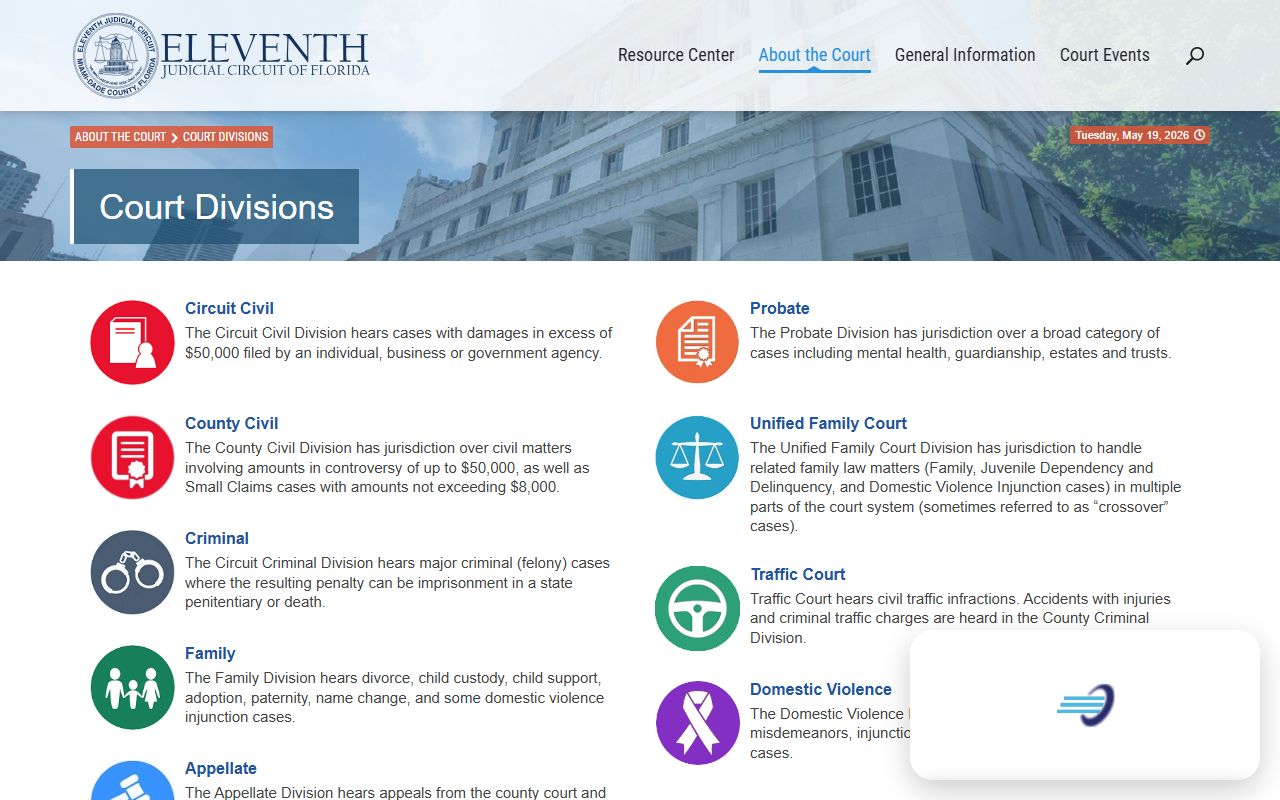
Each division page on jud11.flcourts.org has its own jurisdiction summary, judges list, locations, and hearing calendars.
Miami-Dade Courthouses and Court Buildings
Court work is split across a downtown civil and probate complex, the criminal courthouse, the children's courthouse, and several branch buildings. The Clerk's main contact card lists the Osvaldo N. Soto Miami-Dade Justice Center as the central public office. Felonies and misdemeanors sit at the criminal courthouse. Family and juvenile matters concentrate at the Children's Courthouse near Government Center.
Osvaldo N. Soto Miami-Dade Justice Center
20 NW 1st Avenue
Miami, FL 33128
305-275-1155
Richard E. Gerstein Justice Building
1351 NW 12th Street
Miami, FL 33125
305-275-1155
Note: Miami Beach District Court was temporarily closed for repairs in 2026, per a Clerk homepage notice. Verify your hearing location before traveling.
Types of Court Records in Miami-Dade County
The Clerk maintains case files for every division of the Eleventh Judicial Circuit and Miami-Dade County Court, plus a separate recorder system for deeds and other real-property instruments. Most case dockets are public. Some files are restricted or partly redacted under Florida law.
- Criminal records: felony files at Circuit Criminal, misdemeanors and criminal traffic at County Criminal.
- Civil records: Circuit Civil for disputes over $50,000, County Civil up to $50,000, small claims up to $8,000.
- Family records: divorce, paternity, child support, custody, name change, and adoption.
- Probate records: estates, trusts, guardianship, mental health, and Marchman Act cases.
- Traffic court records: civil traffic infractions, criminal traffic, and CDL matters.
- Official Records: recorded deeds, mortgages, liens, satisfactions, plats, and judgments.
- Juvenile records: generally restricted; only basic calendar lookup with a case number.
Civil Circuit cases can include foreclosure files, complex business litigation, international commercial arbitration, products liability, and tort claims. County Civil handles consumer disputes, small claims, evictions, and limited contract suits. The split matters because the wrong court level or the wrong portal will return no result.
What Miami-Dade Court Records Show
A typical case file in OCS or CJIS displays a header with case identifiers, then a docket of events, parties, hearings, judgments, and documents. The local case number uses a year, six-digit sequence, two-letter case code, and a two-digit location. A state case number adds the Miami-Dade county ID (13) and additional segments. Example local civil: 1973-908535-SP-05. Example state format: 131973CA018464000001.
| Field | What It Shows |
|---|---|
| Case Number | Local or state case identifier, including court code and location. |
| Filing Date | Date the case was opened with the Clerk. |
| Parties | Plaintiff and defendant in civil; petitioner and respondent in family; State of Florida and defendant in criminal. |
| Charges / Cause | Statute cited, count, degree, or civil cause of action. |
| Docket Events | Chronological filings, motions, orders, hearings, and notices. |
| Disposition | Outcome of each charge or claim, including dismissal or judgment. |
| Sentence / Judgment | Punishment, fines, probation, restitution, or civil award. |
| Documents | Scanned filings governed by the Florida Access Security Matrix. |
Documents you can view depend on your role. Public users see less than registered users. Attorneys with a Florida Bar number assigned to the case see the most. Sealed and confidential filings never display online.
Public Access Laws for Miami-Dade Court Records
Florida's open-records framework rests on Article I, Section 24 of the state constitution and Chapter 119 of the Florida Statutes. The Florida Rules of General Practice and Judicial Administration add a court-specific layer through Rule 2.420. Together they make most filings public while carving out narrow categories that stay sealed.
Key statutes and rules:
Florida Statutes Chapter 119: The Public Records Act. Defines public records, sets fee rules, lists exemptions, and authorizes attorney fees against agencies that refuse access.
Florida Statute 119.0714: Court files. Allows removal or redaction of certain court-record images from public internet sites.
Rule 2.420: Public access to judicial branch records, with motions to determine confidentiality and redaction procedures.
County policy allows anonymous requests. A requester does not have to give a name, give a reason, or put the request in writing. Miami-Dade publishes its public records request policies with copy fees, response timelines, and contact options. Email is also a public record, and Clerk pages remind requesters that messages they send may be released.
Records That Are Restricted or Confidential
Florida law protects several categories from ordinary public access. Juvenile delinquency and dependency files are confidential. Adoption files are sealed under Florida Statute 63.162. Mental health and Marchman Act files are protected because they hold clinical information. Sealed and expunged criminal records under Florida Statutes 943.0585 and 943.059 are pulled from public search results.
Family law adds another layer. Financial affidavits, minor identifying information, and some domestic relations documents are removed or redacted online under Rule 2.420. The Official Records page also runs a redaction request workflow for Social Security, bank account, and credit card numbers in recorded instruments.
Note: Sealing restricts public access while leaving records with named agencies. Expunction generally requires those agencies to destroy the records, with statutory exceptions for law enforcement and licensing.
Specialty Courts and Diversion Programs
The Eleventh Judicial Circuit operates several problem-solving divisions. The Miami-Dade Veterans Treatment Court handles eligible veterans with substance use or mental health issues. Successful completion can lead to dismissal or charge reduction. Felony Drug Court holds special bond hearings daily at the criminal courthouse, where qualifying defendants can enter a drug rehabilitation program instead of going to trial.
Unified Family Court follows a "one family, one judge" model so dependency, delinquency, family, and domestic violence injunction cases tied to the same household stay with one judge. The Boot Camp Program at Miami-Dade Corrections is a shock-incarceration alternative for adjudicated young adults ages 14 to 24, accredited by the American Correctional Association since 2004. The Monitored Release Program uses GPS ankle monitoring for both pretrial and sentenced offenders ordered into supervision by the circuit.
Miami-Dade Sheriff and Jail
Miami-Dade got its elected Sheriff's Office back on January 7, 2025, when the former Miami-Dade Police Department transitioned back into a Sheriff's Office for the first time in nearly 60 years. Sheriff Rosie Cordero-Stutz is the county's first female sheriff. The Sheriff's Office headquarters sits at 9105 NW 25th Street in Doral, with a non-emergency line at 305-743-7433.
Jail operations stay with the Miami-Dade Corrections and Rehabilitation Department. MDCR runs the eighth-largest jail system in the country and the largest in Florida, with average daily population in the 4,000 to 4,800 range across four detention facilities: Pre-Trial Detention Center, Turner Guilford Knight Correctional Center, Metro West Detention Center, and the Boot Camp Program. Director Sherea Green leads the department from headquarters in Doral.
Use the Miami-Dade inmate records page for the full roster walkthrough, the released inmates page for bond and discharge details, and the warrant records page for capias and active criminal-case warrants.
Marriage, Divorce, and Probate Records
The Clerk's Marriage License Bureau sits at Overtown Transit Village South. Applicants apply in person, present photo ID, provide a Social Security number if issued, and complete the ceremony within 60 days of license issuance. Divorce records live in the Family Division of the Eleventh Circuit and appear in OCS. The final judgment date is the date of divorce for Clerk search purposes. See the Miami-Dade marriage and divorce records page for fees, forms, and required ID.
Probate is a division of the Eleventh Judicial Circuit, not a separate probate court. It hears estates, trusts, guardianship, mental health, and Marchman Act cases. Six circuit judges and two general magistrates serve in probate at the Soto Justice Center.
- Testator
- The person who wrote the will.
- Executor / Personal Representative
- The person named to manage the estate.
- Intestate
- Dying without a valid will.
- Caveat
- A filing that puts the court on notice before estate administration begins.
- Guardian
- Person appointed to manage a ward's person or property.
Miami-Dade Court and Clerk Fees
The Clerk publishes set fees for copies, certified copies, and searches. County public-records fees follow a separate scale under Chapter 119. Both are listed on the Clerk's Records Library and Official Records pages.
| Item | Amount |
|---|---|
| Recorded document copy | $1 per page |
| Certification of recorded document | $2 |
| Records staff search | $2 per name per year |
| Criminal certified copy / disposition letter | $7 |
| Recording, most documents | $10 first page; $8.50 each added page |
| Lis Pendens recording | $5 first page; $4 each added page |
| Official Records advanced search unit | $1 per unit |
| Marriage certified copy | $9 first copy; $7 each added copy |
| Public records, single-sided page | 15 cents |
| Public records, double-sided page | 20 cents |
Payment methods for recording include cash in person, cashier's check, money order, title-company or attorney checks, and in-person credit card with a daily cap. Personal checks are not accepted for marriage applications or certified marriage copies by mail.
How to Interpret Miami-Dade Court Records
Docket abbreviations and case codes can confuse first-time readers. Local case codes include CA for Circuit Civil, CC for County Civil, CP for Circuit Probate, DR for Domestic Relations, GD for Guardianship, MH for Mental Health, and SC for Summary Civil. Criminal case codes are B for Branch, F for Felony, and M for Misdemeanor.
Florida adds an unusual disposition called withhold of adjudication. The judge accepts a plea or finding of guilt but withholds formal adjudication, so the defendant avoids many civil consequences of a conviction. A capias is the Florida arrest writ, often issued after a failure to appear. Sealing means restricting public access; expunction means destruction by listed agencies. Read every entry carefully because the wording controls the legal effect of the record.
Accuracy and Record Limitations
Online Clerk data updates as filings are docketed, but lag is normal. Newly filed cases, sealed or recently sealed files, juvenile matters, and certain family records may not appear in a public search even when they exist. Document images depend on access role and case type. Certified copies are the only copies most courts and agencies will accept as proof.
Note: Confirm critical facts with the originating Clerk office before relying on an online search result for legal, employment, or housing decisions.
Miami-Dade Court History and Current Initiatives
Miami-Dade was Dade County until the county name changed to Miami-Dade. The historic courthouse at 73 W Flagler Street still anchors the downtown court corridor, though major Clerk and civil functions now run from the Soto Justice Center at 20 NW 1st Avenue. The Eleventh Judicial Circuit's structure follows Florida's 1972 court modernization under Article V, which created the two-tier trial system in use today.
The Clerk is moving services to a .gov domain and has rolled out a wave of new applications: enhanced OCS for civil, family, and probate; the Criminal Justice Online Case Search and Images system (COIN); a new Civil Infractions Application; a Parking Service Assistant; and a Traffic Payment Plan Initiative. On the corrections side, a 2024 county legislative matter advanced a $228 million design-construction contract for a Master Plan Replacement Jail at Site 1.
Frequently Asked Questions
How do I search Miami-Dade court records?
Pick the portal that matches the case type. Civil, family, and probate cases sit in OCS. Criminal cases sit in CJIS. Traffic citations sit in the Traffic Searches application. Deeds, mortgages, and liens sit in Official Records. Searching the wrong portal is the most common reason a record is not found.
Are Miami-Dade court records free online?
Standard online searches are free. Advanced Official Records searches cost $1 per search unit. Enhanced Civil, Family, and Probate access depends on free registration plus the Florida Supreme Court Access Security Matrix. Certified copies are not free.
What is the difference between OCS and CJIS?
OCS covers Civil, Family, and Probate cases. CJIS covers criminal cases including felony, misdemeanor, branch, citation, defendant name, and jail number searches. Criminal traffic can appear in CJIS while civil traffic appears in the Traffic Searches application.
How do I find an inmate in Miami-Dade custody?
Use the MDCR Inmate In-Custody Search. Enter last name followed by first initial or first name. Results show name, date of birth, race, sex, location, charges, bond amount, jail number, booking date, booking time, and mugshot. MDCR inmate information runs at 786-263-7000.
How do I get a certified copy?
Use the Clerk's online certified-copy workflow, or request by mail or in person. Criminal certified copies and disposition letters are $7. Marriage certified copies are $9 for the first copy and $7 for each added copy. Recorded-document copies cost $1 per page plus $2 to certify.
More on the Miami-Dade County Court Records FAQ page.