
Miami-Dade County Court Overview
Every Florida county has a County Court. Miami-Dade County Court is the lower trial court for the county and sits within the Eleventh Judicial Circuit. It handles the local everyday case load: civil disputes with damages up to $50,000, small claims up to $8,000, misdemeanors, criminal traffic, civil traffic infractions, and county or city ordinance violations. The Eleventh Judicial Circuit's official division page spells out the same split. Larger civil cases and felonies move up to the Circuit Court.
County Court files are kept by the Miami-Dade Clerk of the Court and Comptroller, Juan Fernandez-Barquin. The Clerk treats County Court civil and small claims as part of the Civil/Family/Probate Online System and treats County Criminal as part of the Criminal Justice Online Case Search. Traffic infractions have their own search portal. Each file gets a local case number with a two-letter code, and that code tells the searcher which division and which portal holds the case.
County Court judges sit at the criminal courthouse and at several branch buildings around the county. The branch model spreads misdemeanor and traffic dockets out so that drivers and small-claim parties do not all need to come downtown. Civil and small claims work runs through downtown locations and online filing, while criminal and traffic work runs through the criminal courthouse and the branches.
County Court vs Circuit Court
The fastest way to see what County Court does is to compare it side by side with the Circuit Court. The Eleventh Judicial Circuit and the Florida court structure both draw a clean line between the two. County Court takes the smaller civil and the less serious criminal work. The Circuit Court takes the higher-value civil work, the felonies, and family matters.
| County Court | Circuit Court | |
|---|---|---|
| Civil amount | Up to $50,000; small claims up to $8,000 | Above $50,000 |
| Criminal jurisdiction | Misdemeanors, criminal traffic, ordinance violations | Felonies; cases with possible state prison time of one year or more |
| Traffic | Civil traffic infractions | Accidents with injuries and criminal traffic move to County Criminal; serious felony traffic goes here |
| Family / probate | Not heard at County Court | Divorce, custody, child support, paternity, name change, estates, guardianship, mental health |
| Main local case codes | CC, SC, M, B (branch) | CA, CP, DR, GD, MH, F |
| Appeals go to | Eleventh Circuit Appellate Division, then Third DCA | Third District Court of Appeal |
The two courts share the same Clerk and many of the same buildings. They share staff support, calendars, and the same search portals. But the dollar limit and the criminal cutoff are the bright lines. A $40,000 contract case is County Court. A $400,000 contract case is Circuit Court. A misdemeanor battery is County Court. A felony battery is Circuit Court.
County Civil Cases up to $50,000
County Civil is the County Court's main civil docket. Florida statute and the Eleventh Judicial Circuit's civil division description set the cap at $50,000 in the amount in controversy. Typical County Civil files include landlord and tenant evictions, consumer debt collection, replevin actions, small contract claims, auto property damage, breach of warranty, and a long list of other low-dollar disputes. The case code on these files is CC.
Small claims is the County Court's most user friendly track. Small claims caps at $8,000 in damages, not counting interest, costs, and attorney fees. Small claims uses a simpler set of rules and is designed for parties without lawyers. Pretrial conferences are common. Filings, hearings, and final judgments still appear in the public Clerk record under case code SC. Many small claims cases settle at the pretrial conference itself, which is why so many SC files end with a stipulated payment plan or a voluntary dismissal.
A look at the courts work, including the same $50,000 jurisdictional line and how Civil reorganized into a single Civil Division at the Soto Justice Center, comes from the Eleventh Judicial Circuit's own Civil Division page.
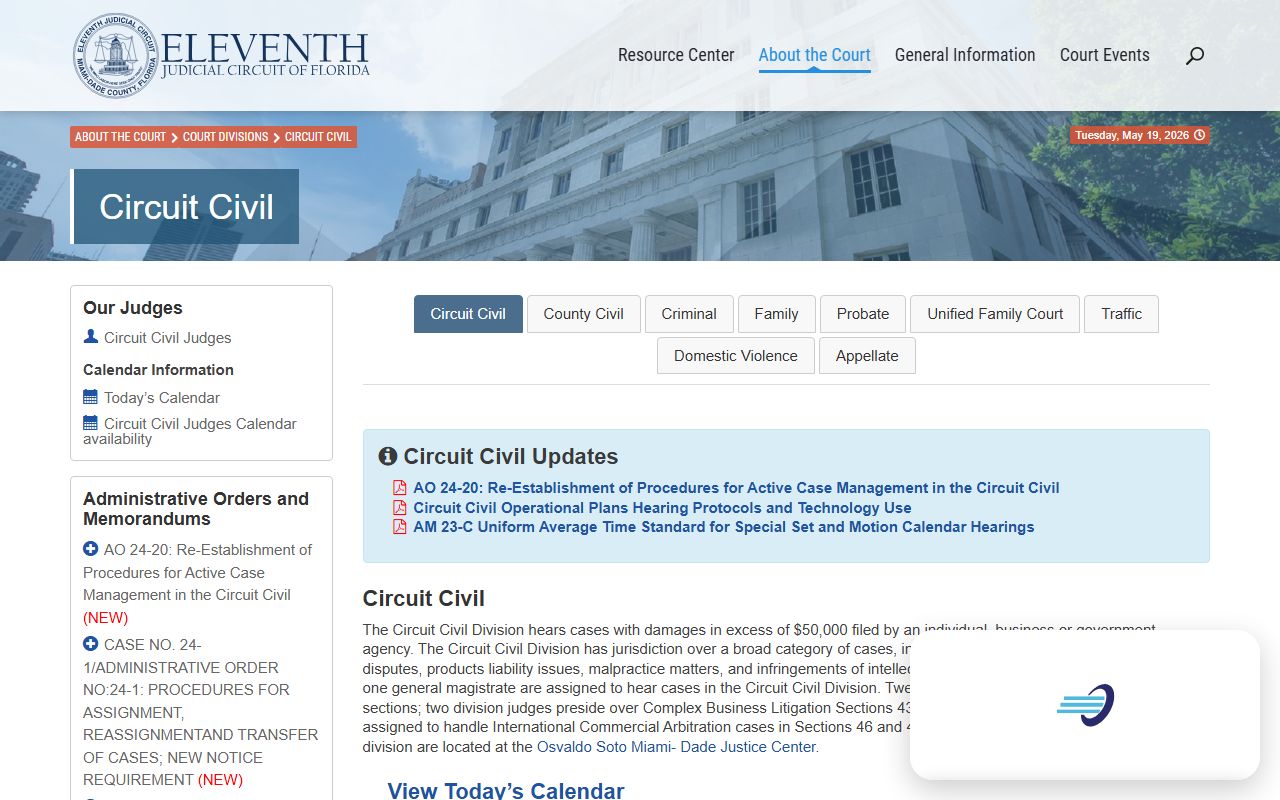
The page confirms the County Civil cap and lists Civil's place inside the Eleventh Judicial Circuit. County Civil and small claims feed straight into the Clerk's OCS portal under case codes CC and SC, which is how the public reaches the docket.
County Criminal: Misdemeanors and Criminal Traffic
County Criminal is the County Court's criminal docket. It hears misdemeanors, criminal traffic, ordinance violations, and certain civil infractions like boating and animal control matters. The case code on misdemeanor files is M. Branch county criminal files (the cases worked out of the branch courthouses rather than the main criminal courthouse) carry case code B. Examples of misdemeanor cases include first or second offense DUI without injury, simple battery, petit theft, trespass, marijuana possession at the misdemeanor level, driving while license suspended, and many city ordinance offenses.
Criminal traffic is the part of County Criminal that handles traffic charges that count as crimes rather than civil infractions. Reckless driving, leaving the scene with damage, and driving while license suspended with knowledge are common criminal traffic charges. They are scored, plea bargained, and disposed of just like other misdemeanors. For broader arrest detail, see Miami-Dade County criminal records.
County Criminal sits at the Richard E. Gerstein Justice Building along with Circuit Criminal. Many ordinance and minor misdemeanor cases run through the branch courthouses. Special felony drug court bond hearings happen daily at the criminal courthouse, and during those hearings some defendants may have the chance to enter a special drug rehabilitation program in place of trial. Branch-coded B files in CJIS are the typical sign that a misdemeanor was handled at a branch rather than downtown.
Civil Traffic Infractions
Civil traffic infractions are the most common County Court matter. Speeding tickets, running a red light, careless driving, no proof of insurance, expired registration, and similar tickets all start as civil traffic infractions. Civil traffic does not produce a criminal record, but it does produce a court record, a fine, and, on the state side, points on the driver license. The Clerk gives civil traffic its own search portal, the Traffic Searches application.
The traffic portal supports search by citation number, case number, defendant name with date of birth, driver license, or tag. Most drivers come to the portal with the citation already in hand. The portal then offers payment, traffic school, or contest options where the violation allows them. For a deeper look at how this docket works and how citations interact with the state driver record, see Miami-Dade County traffic court records.
Accidents with injuries are different. The Eleventh Judicial Circuit moves accidents with injury and other criminal traffic cases to the County Criminal docket. Once a traffic case is criminal traffic, the file lives in CJIS under case code M or B, not in the civil traffic system.
Ordinance and Code Enforcement Cases
County Court hears local ordinance violations under both county and municipal codes. These cases cover things like noise, animal control, occupational licensing, sign code, building code, and zoning matters that have been written as criminal or quasi-criminal ordinances. The case is opened by the issuing agency, not by a private party, and disposition is usually a fine, community service, compliance, or a short jail term where the ordinance allows.
Code enforcement citations sit slightly apart from the criminal docket. They are searched through the Clerk's code enforcement search by citation number, folio number, name, or mailing address. Parking violations have their own track too. Both feed into the County Court for hearings if the cited party requests a contested hearing.
Note: Many ordinance cases never reach a contested hearing because the cited party pays or complies before the hearing date, but the record still appears in the Clerk's search system.
Branch Courthouses Serving County Court
The County Court runs out of the main criminal courthouse and several branch courthouses around Miami-Dade. The Eleventh Judicial Circuit lists the branch courts that hold County Criminal, civil traffic, and county civil dockets. Where the address is on the official site, it is listed below. Where it is not, the branch is named without an invented address.
- South Dade Justice Center, 10710 SW 211 Street, Miami, FL 33189. Branch dockets for the south end of the county.
- Joseph Caleb Center, 5400 NW 22nd Avenue, Miami, FL 33142. Branch and service center site.
- North Dade Justice Center. Branch court for north county dockets; address not published in the official branch snippet captured during research.
- Coral Gables Branch Courthouse. Branch court for Coral Gables and the surrounding area.
- Hialeah Branch Courthouse. Branch court for Hialeah and nearby cities.
- Miami Beach Branch Courthouse. Temporarily closed for repairs and maintenance per a Clerk notice; cases route to other locations until reopening.
The Richard E. Gerstein Justice Building at 1351 NW 12th Street is the main criminal courthouse. County Criminal divisions sit there along with Circuit Criminal. Court hours at Gerstein are 8 a.m. to 5 p.m. Monday through Friday. The Osvaldo N. Soto Miami-Dade Justice Center at 20 NW 1st Avenue is the home of Circuit Civil and the Clerk's main public counter. County Civil and small claims files are processed through the Soto Justice Center and through the same OCS portal, even though the bulk of branch criminal and traffic work runs out of the branch locations.
How to Search County Court Cases
Miami-Dade County Court cases are searched through two main official portals. County Civil and small claims live in the Civil, Family and Probate Courts Online System, called OCS by the Clerk. County Criminal, criminal traffic, and branch criminal files live in the Criminal Justice Online Case Search, called CJIS. The civil traffic infractions sit in the separate Traffic Searches application. For an in-depth walkthrough of all four portals, see Miami-Dade County court records.
Each case code maps to a specific portal and division. Pick the right code first, then the search becomes a single short form. The CC and SC codes go to OCS. The M and B codes go to CJIS. Civil traffic citations go to the traffic portal.
| Code | Type | Court Level |
|---|---|---|
| CA | Circuit Civil | Circuit Court |
| CC | County Civil | County Court |
| SC | Summary Civil / Small Claims | County Court |
| CP | Circuit Probate | Circuit Court |
| DR | Domestic Relations | Circuit Court |
| GD | Guardianship | Circuit Court |
| MH | Mental Health | Circuit Court |
| F | Felony | Circuit Criminal |
| M | Misdemeanor | County Criminal |
| B | Branch | County Criminal (branch courthouses) |
A short step-by-step makes the search smooth.
- Pick the portal that matches the case code. CC and SC use OCS. M and B use CJIS. Civil traffic uses the Traffic Searches app.
- Pick a search method. Local Case Number is fastest if the case number is on hand. Party Name works when only a name is known.
- Enter required fields. OCS Party Name search wants a last name with at least three characters and a first initial to narrow the result. CJIS lets users build the case number from code, year, six-digit sequence, and an optional suffix.
- Solve the reCAPTCHA when prompted. Registered users can skip the CAPTCHA and the result-set limits.
- Open the case card. Filing date, case type, parties, hearings, and document list show on the card. Order Certified Copies is the action used to request an official copy.
For County Court case code definitions in plain English:
- CC
- County Civil. Civil case in County Court with damages up to $50,000.
- SC
- Summary Civil. Small claims case up to $8,000 in County Court.
- M
- Misdemeanor. County Criminal case for an offense punishable by up to one year in jail.
- B
- Branch. County Criminal case handled out of a branch courthouse rather than downtown.
Note: OCS limits unregistered name searches and shows a CAPTCHA; for repeated searches the Clerk asks the user to register for a free Public Access account.
Filing Fees and Process
County Court filing fees follow Florida statute and are collected by the Clerk. Small claims, county civil, evictions, and replevin all carry separate filing fee tiers based on the amount in controversy. Criminal copies have their own fee schedule. The Miami-Dade Clerk of the Court and Comptroller publishes the full fee list and accepts payment in person, by mail, and online for many filings.
Standard certified-copy and search fees include $7 for a certified copy of a criminal disposition letter, with an extra $2 per year per name when the requester does not know the year or case number. Recorded document copies are $1 per page with a $2 certification fee. Records staff searches run $2 per name per year when the public uses staff rather than the public terminals.
Pay attention to the case code on any County Court filing. A CC case in OCS is not the same animal as a CA case, and a B case in CJIS is not the same as an F case. Picking the wrong code at search time, or paying a fee at the wrong counter, slows everything down.
Filing a County Civil or small claims case starts with a complaint or statement of claim, a civil cover sheet, and the filing fee. The Clerk issues a summons. Service goes to the defendant through a process server or, in many small claims cases, by certified mail. After service, the answer period runs, then a pretrial conference or motion practice sets the schedule for trial or settlement.
Appeals from County Court
Appeals from Miami-Dade County Court do not jump straight to the state appellate level. They go first to the Appellate Division of the Eleventh Judicial Circuit Court. A panel of Circuit Court judges hears the appeal on the record from County Court. Most County Court appeals end there.
Further review may run to the Third District Court of Appeal, the intermediate appellate court for Miami-Dade. The Third DCA hears appeals from the Circuit Court and limited certiorari review of Appellate Division decisions. The Florida Supreme Court is the final appellate stop and takes a narrow slice of cases by discretionary review.
Plain process diagram: County Court › Eleventh Circuit Appellate Division › Third District Court of Appeal › Supreme Court of Florida. The path is the same for civil and criminal County Court appeals.
For dockets and live calendar data on these cases, see Miami-Dade County court dockets. For the full Eleventh Judicial Circuit court division layout, see the Eleventh Judicial Circuit court divisions page.